
🐙 Why does an octopus have 3 hearts and blue blood? The Ultimate Deep-Sea Solution

FACTOVATE

October 3, 2025

Why does an octopus have 3 hearts and blue blood

Why does an octopus have 3 hearts and blue blood? As someone who constantly hunts for the most mind-boggling facts, I’ve seen countless biological wonders. Yet, few creatures challenge our understanding of life as much as the octopus. This marine genius, with its soft body and problem-solving intelligence, possesses a circulatory system so unique it raises this immediate and fascinating question. This isn’t a random evolutionary quirk; it’s a brilliant, highly specialized adaptation for survival in the challenging deep-sea world.

The Three-Heart Engine: A Necessary System for an Active Life

If you are wondering why octopuses need three hearts, the answer lies in efficiency and high-energy demand. Unlike humans, who rely on a single, powerful heart, the octopus divides its pumping duties among three.

The Role of Each Heart

  1. Two Branchial Hearts (The Boosters): These two hearts are dedicated solely to moving blood through the octopus’s gills. Their only job is to push deoxygenated blood into the gills to quickly absorb oxygen from the surrounding water. They act like high-pressure boosters.
  2. One Systemic Heart (The Main Pump): This single heart takes the now oxygenated blood from the gills and pushes it out to the rest of the body—the muscles, the organs, and its massive central brain.

This system is a marvel of specialization. However, it’s not without a peculiar drawback: the systemic heart actually stops beating when the octopus swims! Swimming causes a significant drop in blood pressure, making the circulation system temporarily inefficient. This is precisely why does an octopus have 3 hearts and blue blood—the creature prefers to crawl along the seabed. Crawling ensures constant, stable circulation, making it a less exhausting way to travel. This behavioral adaptation is directly linked to its cardiovascular system, something many people overlook.

Why does an octopus have 3 hearts and blue blood? As someone who constantly hunts for the most mind-boggling facts, I've seen countless biological wonders. Yet, few creatures challenge our understanding of life as much as the octopus. This marine genius, with its soft body and problem-solving intelligence, possesses a circulatory system so unique it raises this immediate and fascinating question. This isn't a random evolutionary quirk; it's a brilliant, highly specialized adaptation for survival in the challenging deep-sea world.The Three-Heart Engine: A Necessary System for an Active Life

If you are wondering why octopuses need three hearts, the answer lies in efficiency and high-energy demand. Unlike humans, who rely on a single, powerful heart, the octopus divides its pumping duties among three.

The Role of Each Heart

Two Branchial Hearts (The Boosters): These two hearts are dedicated solely to moving blood through the octopus’s gills. Their only job is to push deoxygenated blood into the gills to quickly absorb oxygen from the surrounding water. They act like high-pressure boosters.

One Systemic Heart (The Main Pump): This single heart takes the now oxygenated blood from the gills and pushes it out to the rest of the body—the muscles, the organs, and its massive central brain.

This system is a marvel of specialization. However, it’s not without a peculiar drawback: the systemic heart actually stops beating when the octopus swims! Swimming causes a significant drop in blood pressure, making the circulation system temporarily inefficient. This is precisely why does an octopus have 3 hearts and blue blood—the creature prefers to crawl along the seabed. Crawling ensures constant, stable circulation, making it a less exhausting way to travel. This behavioral adaptation is directly linked to its cardiovascular system, something many people overlook.

The Blue Blood Secret: Copper vs. Iron

The second part of the mystery—the blue blood—is arguably even more fascinating and is the core reason for the need of three hearts.

Human blood is red because it uses an iron-based protein called haemoglobin to carry oxygen. When oxygen binds to iron, it turns red. The octopus, along with other cephalopods, uses a copper-based protein called haemocyanin. When haemocyanin binds with oxygen, it turns a vibrant blue.

Why Copper is Superior in the Deep Sea

This copper-based haemocyanin is a vital adaptation for the octopus's habitat.

Low-Oxygen Survival: Haemocyanin is scientifically proven to be far superior to iron-based haemoglobin in binding and transporting oxygen in cold water and environments with low oxygen concentration. This is crucial for deep-sea species. For example, the Antarctic octopus has been studied to show a remarkably high concentration of haemocyanin in its blood, allowing it to thrive in frigid, oxygen-scarce conditions where red-blooded creatures would struggle. This makes the blue blood a literal life-saver.

A Necessity for Energy: An octopus has one of the highest metabolic rates (energy usage) among all invertebrates. It is an extremely active and intelligent animal. This high demand for constant oxygen, especially in an often-depleted oxygen environment, is the fundamental reason why does an octopus have 3 hearts and blue blood. The three hearts work hard to compensate for the haemocyanin being slightly slower at releasing oxygen to the tissues compared to human blood, but its ability to grab oxygen in a low-supply area is unmatched.

Evolutionary Brilliance: How Old is the Octopus's Design?

To appreciate this unique biology, consider the octopus’s timeline. It’s a creature of ancient lineage. Latest fossil discoveries suggest that octopus ancestors were swimming in the oceans 330 million years ago—long before the dinosaurs roamed the Earth. This long history of survival in diverse ocean conditions shows just how successful their body plan is.

The need for a super-efficient oxygen delivery system has been a continuous evolutionary pressure. As they evolved to have complex behaviors and bigger brains, their circulatory system had to keep up. The three-heart, blue-blood design is a time-tested solution that has kept the octopus thriving for hundreds of millions of years.

Fueling Genius: The Octopus's Nine Brains

When we discuss the incredible biology of the octopus, we simply cannot ignore its famously complex nervous system. In addition to understanding why does an octopus have 3 hearts and blue blood, it's crucial to know that the octopus has one central brain (doughnut-shaped, encircling its esophagus) and a large cluster of nerve cells (often called "mini-brains" or ganglia) at the base of each of its eight arms. This effectively gives the octopus nine distinct "brains"!

This vast network of neurons—approximately two-thirds of which are located within its arms—requires a massive, constant, and efficient supply of oxygen. The three hearts and the blue blood are not just biological oddities; they are the sophisticated logistical system that powerfully supports the octopus's legendary intelligence, incredible dexterity, and unique ability to interact with its environment. The entire biological setup is a marvel of evolutionary design, built to give this soft-bodied creature the speed, agility, and cognitive power it needs to survive in a predator-rich ocean.

In my personal experience as a fact-finder, whenever I encounter a question like "Why does an octopus have 3 hearts and blue blood?", I’m reminded that nature always finds the most ingenious solution. The octopus's blue blood and multiple hearts are simply the most effective way for this magnificent, intelligent creature to conquer the cold, demanding environment of the deep ocean.
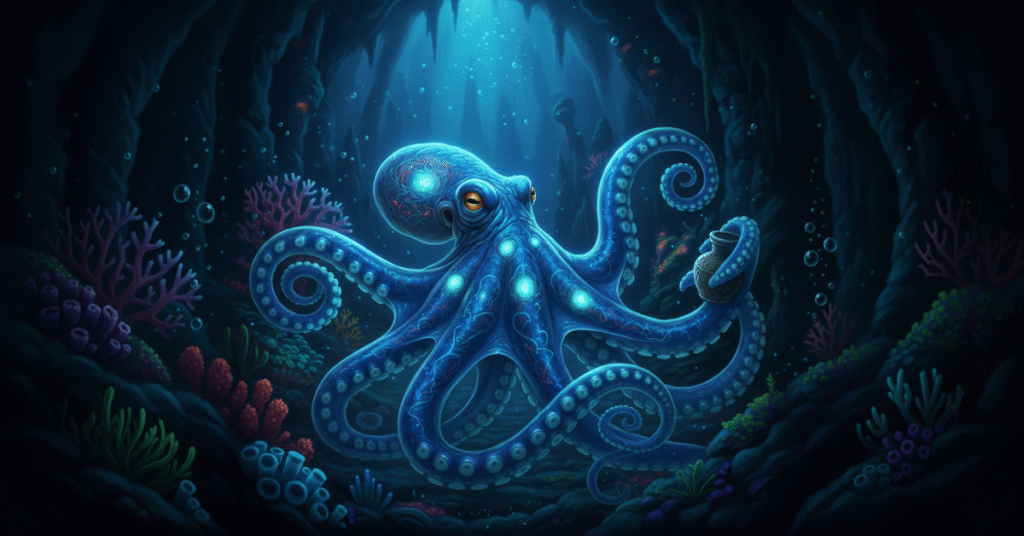
This visual is an AI-generated illustration to enhance the educational content of this article.

The Blue Blood Secret: Copper vs. Iron

The second part of the mystery—the blue blood—is arguably even more fascinating and is the core reason for the need of three hearts.

Human blood is red because it uses an iron-based protein called haemoglobin to carry oxygen. When oxygen binds to iron, it turns red. The octopus, along with other cephalopods, uses a copper-based protein called haemocyanin. When haemocyanin binds with oxygen, it turns a vibrant blue.

Why Copper is Superior in the Deep Sea

This copper-based haemocyanin is a vital adaptation for the octopus’s habitat.

  • Low-Oxygen Survival: Haemocyanin is scientifically proven to be far superior to iron-based haemoglobin in binding and transporting oxygen in cold water and environments with low oxygen concentration. This is crucial for deep-sea species. For example, the Antarctic octopus has been studied to show a remarkably high concentration of haemocyanin in its blood, allowing it to thrive in frigid, oxygen-scarce conditions where red-blooded creatures would struggle. This makes the blue blood a literal life-saver.
  • A Necessity for Energy: An octopus has one of the highest metabolic rates (energy usage) among all invertebrates. It is an extremely active and intelligent animal. This high demand for constant oxygen, especially in an often-depleted oxygen environment, is the fundamental reason why does an octopus have 3 hearts and blue blood. The three hearts work hard to compensate for the haemocyanin being slightly slower at releasing oxygen to the tissues compared to human blood, but its ability to grab oxygen in a low-supply area is unmatched.


Evolutionary Brilliance: How Old is the Octopus’s Design?

To appreciate this unique biology, consider the octopus’s timeline. It’s a creature of ancient lineage. Latest fossil discoveries suggest that octopus ancestors were swimming in the oceans 330 million years ago—long before the dinosaurs roamed the Earth. This long history of survival in diverse ocean conditions shows just how successful their body plan is.

The need for a super-efficient oxygen delivery system has been a continuous evolutionary pressure. As they evolved to have complex behaviors and bigger brains, their circulatory system had to keep up. The three-heart, blue-blood design is a time-tested solution that has kept the octopus thriving for hundreds of millions of years.


Fueling Genius: The Octopus’s Nine Brains

Why does an octopus have 3 hearts and blue blood
This visual is an AI-generated illustration to enhance the educational content of this article.

When we discuss the incredible biology of the octopus, we simply cannot ignore its famously complex nervous system. In addition to understanding why does an octopus have 3 hearts and blue blood, it’s crucial to know that the octopus has one central brain (doughnut-shaped, encircling its esophagus) and a large cluster of nerve cells (often called “mini-brains” or ganglia) at the base of each of its eight arms. This effectively gives the octopus nine distinct “brains”!

This vast network of neurons—approximately two-thirds of which are located within its arms—requires a massive, constant, and efficient supply of oxygen. The three hearts and the blue blood are not just biological oddities; they are the sophisticated logistical system that powerfully supports the octopus’s legendary intelligence, incredible dexterity, and unique ability to interact with its environment. The entire biological setup is a marvel of evolutionary design, built to give this soft-bodied creature the speed, agility, and cognitive power it needs to survive in a predator-rich ocean.

In my personal experience as a fact-finder, whenever I encounter a question like “Why does an octopus have 3 hearts and blue blood?”, I’m reminded that nature always finds the most ingenious solution. The octopus’s blue blood and multiple hearts are simply the most effective way for this magnificent, intelligent creature to conquer the cold, demanding environment of the deep ocean.


Leave a Comment