
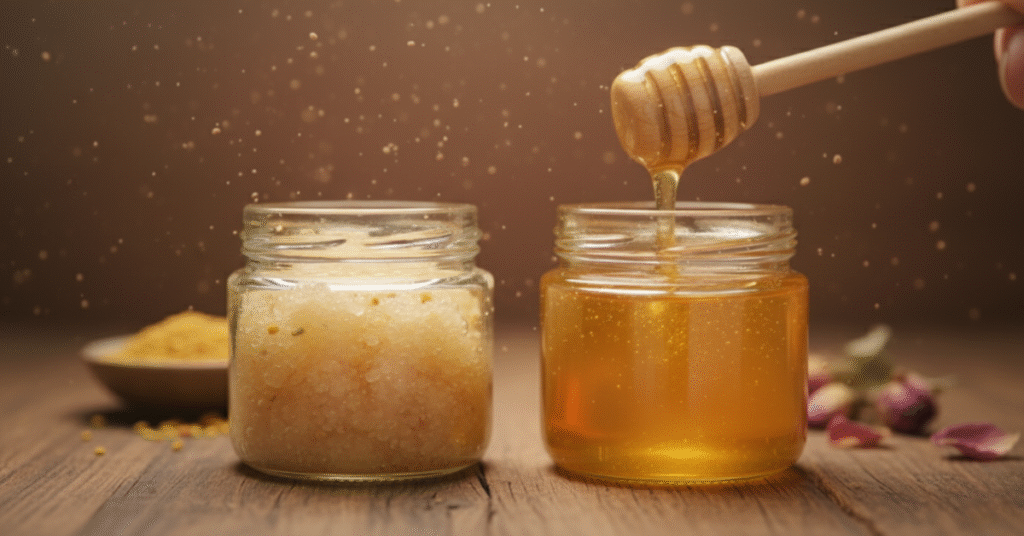
It’s happened to all of us. You reach into the pantry for a spoonful of liquid gold, only to find your favourite jar of honey has turned thick, grainy, and solid. The immediate question that pops into your mind is, does crystallized honey mean it’s spoiled? For new honey users, this sudden transformation often causes panic, leading many to mistakenly toss out a perfectly good, natural product. The sweet truth, backed by centuries of history and modern science, is an emphatic No. That grainy texture is actually a sign of purity, not spoilage, and understanding this simple fact is key to enjoying one of nature’s most enduring foods.
The Immortal Nature of Honey (The Real Fact)

To understand crystallization, we must first appreciate the astounding fact: pure honey is practically immortal. Archaeologists have famously discovered pots of edible honey in ancient Egyptian tombs—some over 3,000 years old! So, why does honey never truly go bad? It’s a combination of unique properties:
-
Low Moisture Content
Honey contains very little water, typically less than 18%. Microorganisms like bacteria and yeast need moisture to survive and multiply, but honey’s low water content essentially dehydrates them, making it an extremely hostile environment.
-
Natural Acidity
Honey has a naturally low pH level, usually between 3.2 and 4.5. This acidity is too high for most spoilage-causing microbes, acting as a second layer of defense.
-
Hydrogen Peroxide
Bees add an enzyme called glucose oxidase to the nectar. This enzyme creates tiny amounts of hydrogen peroxide, a powerful natural antiseptic, further ensuring the honey’s stability and longevity.
What Exactly is Crystallization and Why Does It Happen?

Crystallization, also known as granulation, is a completely natural process. It is not a sign of spoilage; rather, it is the result of a scientific imbalance that is trying to correct itself.
My Experience (Sharing Human-Like Insight): When I first saw a jar of expensive Manuka honey turn solid years ago, I almost threw it away. I genuinely thought it was defective or spoiled. It was only after researching the science behind it that I realised I was holding a testament to the honey’s quality. I learned to look for that graininess as a good sign!
Crystallization occurs because honey is a super-saturated solution of two main sugars: Glucose and Fructose.
- Glucose’s Role: Glucose has a tendency to separate from the water in the honey solution. Once it separates, it forms tiny, white crystals.
- Fructose’s Stability: Fructose is more soluble in water and remains liquid, but as more glucose crystals form, the entire mass thickens and turns grainy.
The speed at which this happens depends on three main factors:
- Temperature: Honey stored in cooler temperatures (around 10°C to 15°C) will crystallize fastest.
- Source/Flower Nectar: Honey from certain flowers (like clover or sunflower) that have a higher glucose-to-fructose ratio will crystallize much faster than others (like acacia).
- Purity: Raw, unfiltered honey that contains pollen particles crystallizes faster, as these particles act as ‘seeds’ for the crystals to form around.
The Key Question: Does Crystallized Honey Mean It’s Spoiled?
This brings us back to our core keyword: does crystallized honey mean it’s spoiled? Absolutely not. Spoiled honey is very rare and happens only under extremely specific conditions, usually due to poor storage.
How to Differentiate Crystallization from Spoilage
| Crystallized Honey (Normal & Safe) | Spoiled Honey (Rare & Bad) |
| Texture: Thick, grainy, solidified. | Texture: Thin, bubbly, and excessively foamy (fermentation). |
| Smell: Sweet, familiar honey aroma. | Smell: Strong, sour, alcoholic, or yeasty odour. |
| Appearance: Cloudy or solid, but consistent. | Appearance: May have mold patches on the surface due to water contamination. |
If your honey has simply turned solid, it is perfectly safe, nutritious, and ready to be enjoyed. The answer to does crystallized honey mean it’s spoiled will always be a reassurance of its natural quality.
How to Bring Crystallized Honey Back to Liquid Form

Luckily, reversing crystallization is simple. This process is called de-crystallization.
- The Warm Water Bath:
- Loosen the lid of the honey jar.
- Place the jar in a pot of warm (not boiling) water.
- Maintain the water temperature below 40°C (104°F) to protect the beneficial enzymes.
- Stir the honey occasionally until the crystals dissolve and the honey is fully liquid again.
Final Verdict on Honey’s Longevity
In conclusion, for those wondering does crystallized honey mean it’s spoiled, remember the fascinating science that makes this food almost eternal. The natural properties of low water, high acidity, and a touch of hydrogen peroxide protect it from microbial attack. Crystallization is merely a physical change, a natural testament to its raw, super-saturated state. Enjoy your honey, whether it’s runny or solid, knowing you have one of the planet’s most incredible and longest-lasting pantry items.