
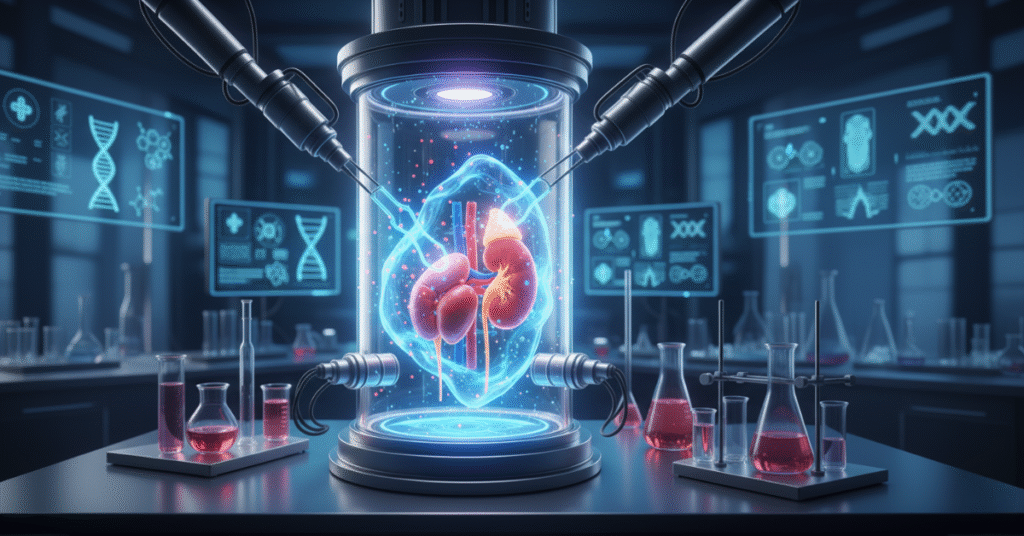
When you run a site like Factovate, you come across many amazing scientific discoveries. But rarely does a discovery feel like a genuine, life-changing miracle. This is exactly how I feel about the latest medical breakthrough that has successfully created the enzyme converted O kidney. This groundbreaking technology is not just another step in medicine; it’s a giant leap that has the potential to eliminate the agonizing wait for thousands of patients needing a kidney transplant worldwide.
The Current Crisis: Why Blood Type Matters So Much

Before we dive into this incredible solution, it’s important to understand the scale of the problem. For any solid organ transplant, blood type compatibility (ABO system) is crucial. If a patient with Type O blood receives a Type A kidney, their immune system immediately recognizes the A-antigens (the “nametags” on the kidney’s cells) as foreign invaders. The reaction is swift, violent, and often fatal—it’s called hyperacute rejection.
This biological restriction creates a huge imbalance:
- Type O Patients Wait the Longest: Patients with Type O blood, the most common blood type, can only receive a Type O kidney. However, since Type O organs are “universal donors” (can go to A, B, AB, or O recipients), they are always in high demand and short supply.
- Wastage of Organs: Conversely, perfectly healthy Type A or Type B organs often cannot be used because there is no matching recipient available in time, leading to the heartbreaking discard of viable organs.
The Breakthrough: What is the Enzyme Converted O Kidney (ECO)?
The new approach is brilliant in its simplicity: instead of trying to adjust the patient (a process called desensitization, which is risky and expensive), scientists now adjust the organ before it even leaves the operating table.
The technique, successfully demonstrated in a landmark experiment in October 2025, involves using special enzymes to “wash” the kidney. Our focus keyword, enzyme converted O kidney, literally describes the process where a kidney of an incompatible type (like A or B) is treated with specific enzymes. These enzymes act like molecular scissors that snip off the A or B antigens (sugar molecules) from the inner lining of the kidney’s blood vessels.
The result? The kidney is left with only the basic marker, the H-antigen, making it immunologically equivalent to a Type O universal donor organ. This effectively removes the biggest barrier to transplantation.

A Donor-Centric Strategy: Faster and Safer Transplants
In the past, to bypass a blood type mismatch (ABO-incompatible transplants), doctors had to use a “recipient-centric” approach. This involved weeks of complex, expensive, and risk-filled procedures—like plasmapheresis—to temporarily lower the patient’s own antibodies. The new enzyme converted O kidney strategy is “donor-centric,” changing the organ itself.
This shift offers huge advantages:
- Speed: The conversion process is rapid, taking only a few hours during machine perfusion, a standard procedure used to keep the organ viable during transport. This speed is critical because every hour an organ is out of the body affects its quality.
- Safety: It avoids the need for heavy, pre-transplant antibody suppression in the patient, potentially reducing the risk of severe infections and complications after surgery.
The Future: What’s Next for the Enzyme Converted O Kidney?
In the first human test, the enzyme converted O kidney (which was a Type A kidney) was successfully transplanted into a brain-dead Type O recipient (with family consent for research). The outcome was tremendously promising: there was no hyperacute rejection for the first 48 hours. This confirms the immediate efficacy of the enzyme wash.
However, the scientists also noted that after a few days, the antigens began to re-emerge, causing a mild, delayed immune response. This tells us the technology is not perfect yet, but it gives the medical community a clear roadmap. The next phase of research will focus on finding ways to permanently prevent the antigen regeneration or manage this mild, delayed rejection. The journey to a truly enzyme converted O kidney that lasts a lifetime is still ongoing, but the most difficult part—preventing the immediate, fatal reaction—has been solved.
Conclusion: A New Chapter in Organ Donation
For the countless people on waiting lists, this innovation provides a renewed sense of hope. The ability to use the enzyme converted O kidney to match any patient means the deceased donor pool can be utilized far more efficiently and equitably. This is a story of human ingenuity taking on one of biology’s most stubborn obstacles. As this research moves into larger clinical trials, we are truly witnessing the beginning of the end of the long and uncertain wait for a life-saving transplant.