
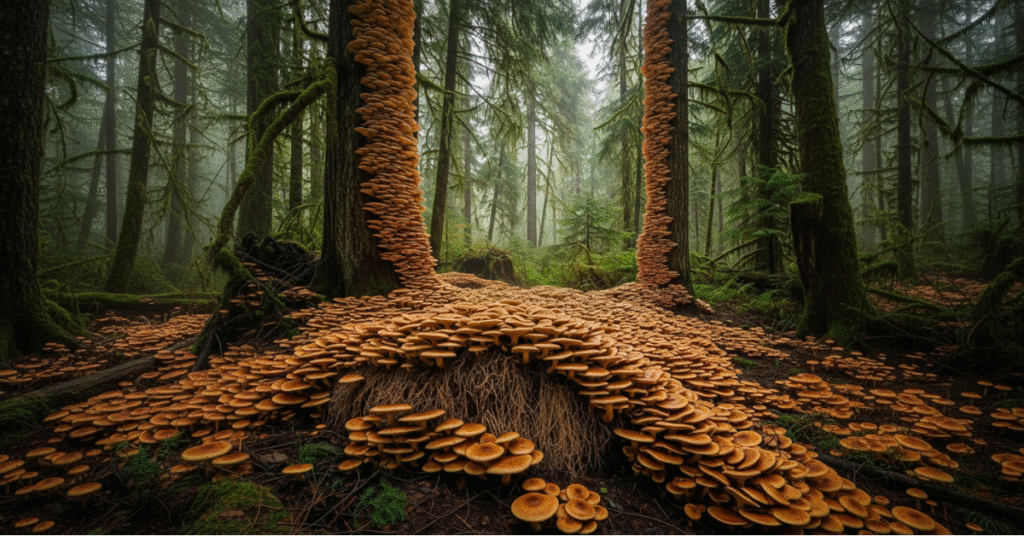
You might have always thought that the world’s largest living organism is a Blue Whale, living in the deepest parts of the ocean, or perhaps a towering Giant Sequoia tree in America. While both of these are incredibly massive, the truth is far more surprising.
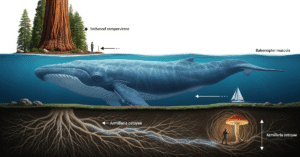
When we set out to find the world’s largest living organism, we have to go deep underground, into a dense and quiet forest, where it has been slowly spreading for thousands of years.
It is neither an animal nor a tree. It is a fungus, commonly known as the Honey Mushroom. Its scientific name is Armillaria ostoyae. This fungus doesn’t live in just one spot, but is spread beneath the soil across a huge area of 2,200 acres in Oregon’s Malheur National Forest.
Imagine that! 2,200 acres is not a small area; it’s equal to about 1,660 football fields. Scientists estimate that it weights more than 35,000 tons and has been alive for at least 2,400 years and possibly even longer.
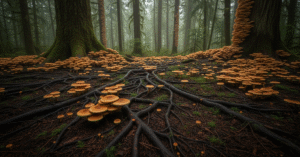
This fungus expands itself through a network of root-like structures called “mycelial cords.” These cords spread through the soil and tree roots like a giant network. Because of this interconnected web, it is considered a single organism. It’s often called the “humongous fungus.”




Thank you for your sharing. I am worried that I lack creative ideas. It is your article that makes me full of hope. Thank you. But, I have a question, can you help me?
Thank you so much for your kind words! I am truly honored that my article inspired you and gave you hope. Creativity is a journey, and we all start somewhere—staying curious is the first step! Please feel free to ask your question, and I will do my very best to help you.