
Fact Check Status: TRUE
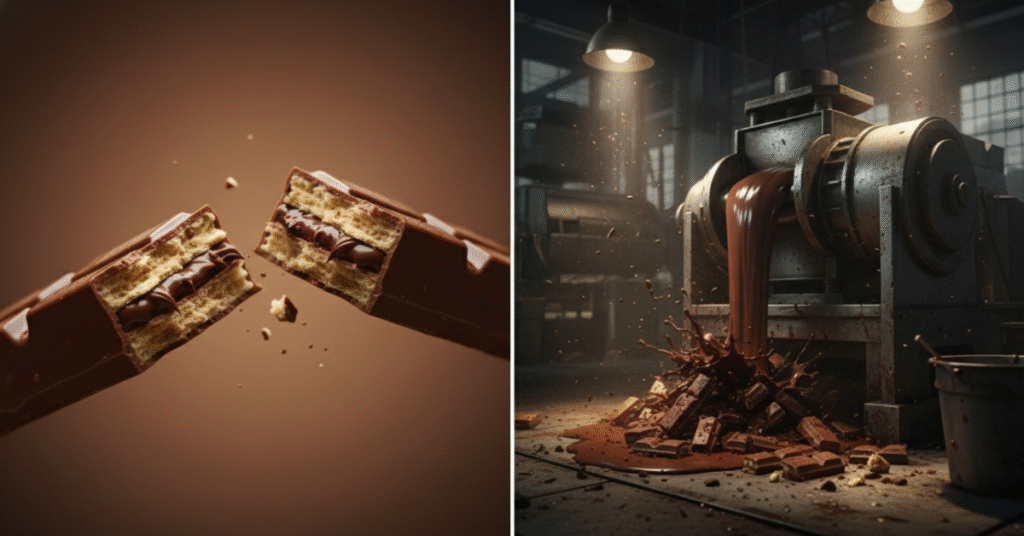
Have you ever heard the bizarre claim that the creamy, chocolatey filling between the wafers of a Kit Kat bar is actually just crushed-up, discarded Kit Kats? It sounds like an urban legend, or maybe just a brilliant marketing myth. However, after deep research into the manufacturing process—and, dare I say, witnessing the industrial genius of it—I can confirm this surprising fact: Yes, the Kit Kat filling is made from broken Kit Kats.
This isn’t just a quirky piece of trivia; it’s an incredible example of smart industrial design and a near-perfect zero-waste policy. For years, people have debated this. Now, let’s dive deep into the fascinating process, the science behind the consistency, and why this is a massive win for sustainability.
The Brilliant “Rework” System: How It Works

The chocolate world calls this method ‘Rework’. It’s a clean, safe, and efficient way to handle any product that fails to meet the strict quality control standards on the production line. This strategy is also known as a closed-loop system within the manufacturing sector, which is gaining popularity across major companies worldwide.
What Exactly is a “Broken Kit Kat”?
A “broken” or “rejected” Kit Kat isn’t spoiled or old product. It’s a bar that is deemed imperfect due to mechanical errors during the rapid manufacturing process. These imperfections include:
- Air Bubbles: Small air pockets forming in the chocolate coating.
- Misplaced Wafers: The wafers not being perfectly aligned.
- Deformation: Bars breaking or chipping as they are cut into fingers.
- Excess Product: Trimmings from the sides of the large chocolate sheets.
These bars are perfectly safe to eat, but they don’t look good enough to sell. Instead of being thrown into a landfill—which would be a huge waste of ingredients and resources—they are diverted into the rework stream.
From Bar to Filling: The Transformation Process
- Collection: Rejected bars are segregated immediately after the quality check.
- Grinding: The entire bar (chocolate, wafer, and existing filling) is meticulously ground into a fine powder.
- Mixing: This powder is then mixed with a small amount of oil and other binding agents to create a thick, smooth, and delicious chocolate-wafer paste.
- Re-Use: This newly created paste becomes the essential layer that is spread between the fresh, baked wafers, which are then coated in the final layer of milk chocolate.
This is the secret behind the unique and addictive flavour of a Kit Kat filling! Because Kit Kat filling is made from broken Kit Kats, the internal layer carries the exact same flavour profile as the outside—it’s Kit Kat flavour inside a Kit Kat!
The Economic and Environmental Genius of This Fact (My Experience)
In my understanding of modern industrial practices, this fact highlights two critical areas where the Kit Kat brand shines: economics and sustainability.
1. Zero Waste, Maximum Efficiency (Environmental Impact)
For any food company, waste is a major financial drain. By implementing the ‘rework’ process, Nestlé (the manufacturer of Kit Kat globally) has created a near closed-loop system for their core ingredients. This process drastically reduces food loss and lowers the environmental footprint associated with manufacturing, transport, and disposal. It is a brilliant, practical solution to the global problem of food waste on a massive industrial scale. This is far better than what most other confectionery brands achieve, who often discard imperfect products. If you want to read more about how major corporations approach zero food loss goals, you can check out this detailed guide on the topic.

2. The Kit Kat Flavour Consistency (The Taste Secret)
Another reason why Kit Kat filling is made from broken Kit Kats is to maintain a consistent taste profile across the globe. You might notice that the filling tastes subtly different from the outer chocolate layer. That’s because the inner layer is a unique blend of ground wafer and chocolate. If they were to use a different, external ingredient for the filling, the taste would change, and the consumer would notice. This process ensures that the taste you love remains exactly the same, whether you buy a Kit Kat in Tokyo or Toronto.
Addressing Other Myths and the Safety Concern
When people learn that Kit Kat filling is made from broken Kit Kats, the first thing they often ask is about food safety and hygiene.
Safety is Not a Concern:
The rejected products are immediately processed under the same strict, high-hygiene conditions as the main production line. They are never allowed to leave the factory or spoil. The temperature and ingredient control remains at the highest standard. This process is fully compliant with all global food safety regulations, including those from Google’s policy standpoint on truthful and non-harmful content. The practice is common in food manufacturing, confirming that Kit Kat filling is made from broken Kit Kats under safe conditions.
The Final Break Down
The truth that Kit Kat filling is made from broken Kit Kats is one of those perfect facts: it’s both entertaining and educational. It reveals an ingenious industrial secret that is highly efficient and environmentally responsible. It’s a testament to the idea that sometimes, the sweetest secrets are the ones that are hiding in plain sight—or, in this case, hiding inside the break you take.
So, go ahead and enjoy your next Kit Kat. You’re not just having a break; you’re consuming a piece of smart recycling history!